
What would it take to make Chicago a longevity capital?


Fact checked by Derick Wilder
The term blue zone refers to regions around the world where people live exceptionally long, healthy lives. Sardinia, Italy; Okinawa, Japan; and Loma Linda, California are among them.
Research over the past 20 years has suggested that residents of blue zones share common lifestyle characteristics, including natural movement, mindful eating, community connection, and purpose. Today, public health organizations across the United States are tapping into blue zone philosophy to shape how Americans move, eat, and live.
In Chicago, though, a history of racial segregation and systemic injustice gets in the way of making the city a blue zone for all.
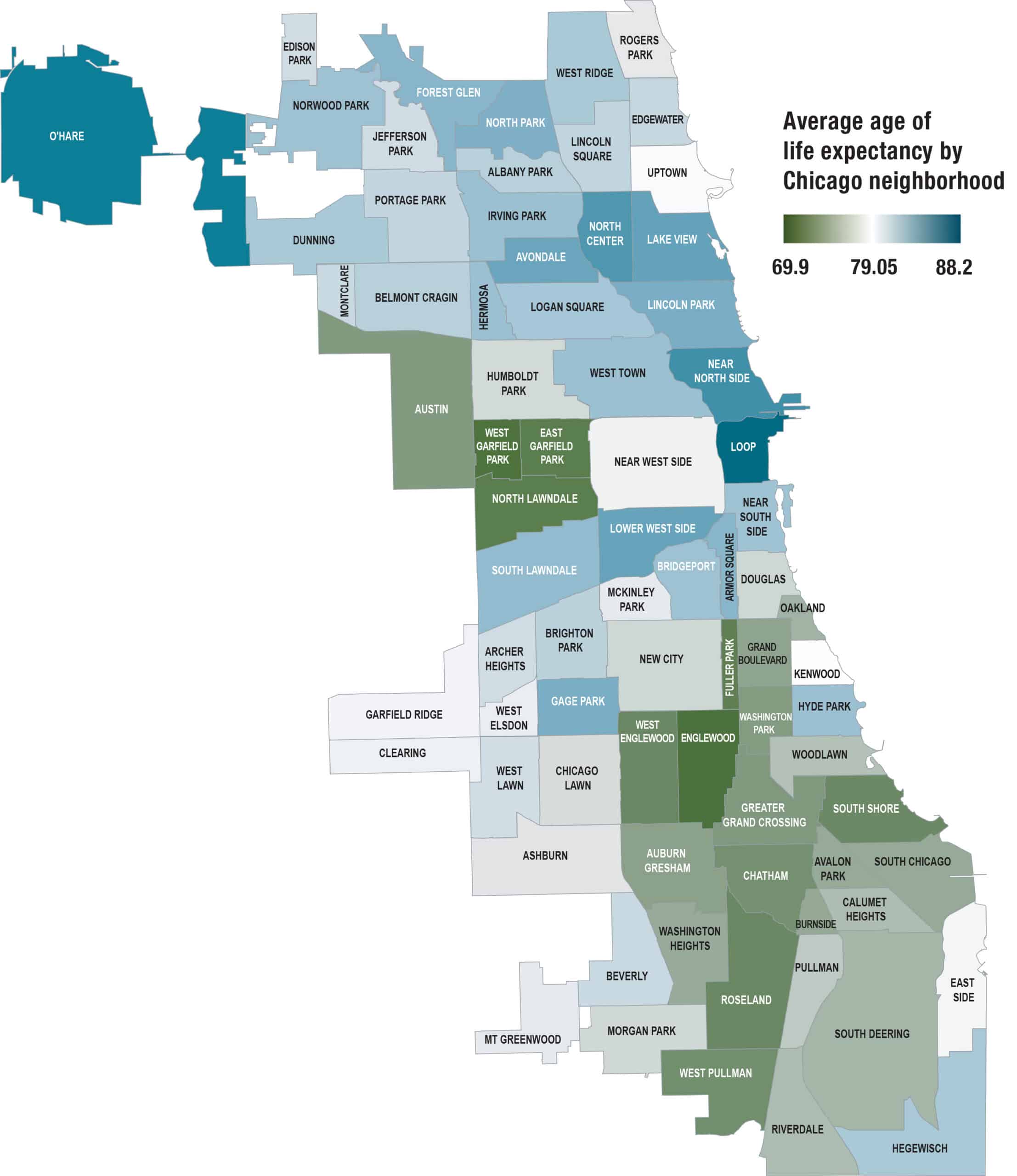
For decades, life expectancy has varied significantly along racial, socioeconomic, and neighborhood lines. According to the Chicago Department of Public Health’s Chicago Health Atlas, the average life expectancy for a child born in Englewood in 2024 was 69.9 years, compared with 88.2 years if born in the Loop. To the south, Hyde Park and Woodlawn border opposite sides of Midway Plaisance Park, yet life expectancy in Hyde Park is seven years longer (82.5 years) than Woodlawn (75.4 years).
Alex Sloboda, MD, medical director at the Chicago Department of Public Health (CDPH) and an emergency medicine physician at Cook County Stroger Hospital on the Near West Side, says four main factors influence longevity: genetics, social determinants of health, environment, and individual behavior.
To manage genetic and lifestyle risks, Sloboda recommends that people build strong relationships with primary care providers. These providers can order routine health screenings based on age, family history, and other risk factors, as well as help prevent, identify early, and manage chronic disease, a leading cause of illness, death, and disability in the U.S.
The social determinants of health include nonmedical factors that affect your well-being: your income, job, where you live, the people in your community, and available resources. These factors can be difficult to change, especially for people from historically marginalized communities or those affected by systemic injustice.
“Longevity isn’t just about individual habits or even access to healthcare,” says Fikirte Wagaw, CDPH’s acting commissioner. “Those things are necessary, but not sufficient [on their own] for a community to be supportive of health.”
The city’s initiatives to improve social determinants of health for all residents overlap with blue zones principles, focusing on expanding access to public spaces and walkable streets, and emphasizing natural movement and social connection.
“Food is central to the blue zone way of life. The blue zone framework encourages a primarily plant-based diet and eating until about 80% full.”
Last year, CDPH released the Healthy Chicago 2025 Strategic Plan report, which focused on reducing Chicago’s racial life expectancy gap of 11.4 years between Black and non-Black Chicagoans. East Garfield Park, West Garfield Park, North Lawndale, Englewood, and West Englewood are priority areas, and the city has committed to centering community members and organizations in its work.
“We recognized that we wanted and needed a new way of having a community voice in how we were distributing relatively scarce public health dollars, asking them not just to identify the priority issues but what to do about them,” Wagaw says. “It’s really designed to bring resources and support directly into neighborhoods by partnering with community-based organizations who are trusted and known in the respective communities.”
So how are Chicagoans taking action at the government, community, and individual levels to infuse blue zone philosophy into their daily lives? Let’s take a look at some of the key blue zone pillars.
Movement
In Sardinia, Italy, one of the original blue zones, residents scale rugged terrain as they walk from place to place, incorporating physical activity naturally into daily life.
However, in Chicago, exercising outside or even walking to a local gym isn’t always a safe bet, depending on where you live in the city. Between 2020 and 2024, Englewood alone logged 97 gun-related deaths, compared with only six in the Loop during the same period.
CDPH is trying to create a more positive presence in specific neighborhoods to support citizens’ ability to exercise safely. Through the PlayStreets program, and in collaboration with community-based organizations and alders, CDPH hosts block parties in neighborhoods with high rates of gun violence, ensuring residents have a safe place to be active outside. More than 200 PlayStreets events were scheduled during summer 2026.
Sloboda also suggests avoiding quick fixes and instead taking advantage of Chicago’s green spaces and public parks. The Chicago Park District’s indoor facilities offer free or low-cost access to dance classes, gym equipment, athletic courts, and pools year-round. Residents can also check out recreational equipment, including tennis rackets, pickleball sets, basketballs, footballs, and beach games for free from Chicago Public Library’s Library of Things.
Healthy food choices
Food is central to the blue zone way of life. The blue zone framework encourages a primarily plant-based diet and eating until about 80% full.
Not all Chicagoans have easy access to healthy and affordable food. From 2020 to 2024, Englewood had only one major grocery store, while the Loop had four.
Since 2017, Black-led nonprofit Grow Greater Englewood has fought food insecurity by operating a network of urban farmers and facilitating the sale of fresh produce at local markets.
The organization’s farming work aims to expand access to affordable, healthy produce in the area, especially after the July 2026 closures of seven Save A Lot grocery stores throughout the South and West sides. “We realized that really good quality food is often really expensive,” Anton Seals, Jr., Grow Greater Englewood’s lead steward and executive director, said during a tour he gave during the Aspen Climate Fest.
Next year, Grow Greater Englewood plans to open the Englewood Agro-Eco District, an urban agricultural zone and green space including a 2-mile elevated nature trail, similar to the 606, which connects Wicker Park, Bucktown, Humboldt Park, and Logan Square. The space will offer more opportunities for natural movement in the local community.
De-stress and connect
Many of those involved with Grow Greater Englewood grew up in the neighborhood or nearby. A key feature of blue zone living is “ikigai,” the concept of identifying and honoring one’s personal purpose in life, while other blue zone principles emphasize building social connections and acting in service to others. By working together to increase food access for their communities, Grow Greater Englewood’s team members may experience the benefits of multiple blue zone principles at once.
Sloboda also advocates for prioritizing mental health and discussing the subject openly with primary care and mental health providers. This is consistent with the blue zone principle of “downshifting,” or minimizing stress to reduce chronic inflammation.
“Evaluate the stressors in your life,” Sloboda says. “When you recognize those things, when you start to deal with those things in a healthy way, that also improves your overall health, and how you take care of yourself and the people around you.”
Many Chicago Public Library branches provide free mental health resources, including walk-in crisis support, therapy with mental health clinicians, and access to telepsychiatry services.
In the end
Even if you follow every blue zone philosophy, public health still matters. One crucial step to protect your longevity is staying up to date with recommended vaccinations. “Immunizations are one of the few direct public health inventions we have that will literally prevent something bad from happening,” Sloboda says. “We always think of immunizations as one of the foundations of public health and longevity.”
For Wagaw, CDPH’s mission to address the life expectancy gap is rooted in the “foundational belief that all Chicagoans have a right to a long and healthy life. It shouldn’t matter how much money you have or where you live.”
Originally published in the Fall 2026/Winter 2027 print issue.

A health journalist and attorney who lives in Chicago, Kimberly covers science, health and the environment as a graduate student at Northwestern’s Medill School of Journalism. She hopes to use her knowledge of public health and law to communicate complex issues to the general public.


