Burnout and a strained healthcare system are forcing medicine to confront how it cares for its own


Fact checked by Shannon Sparks
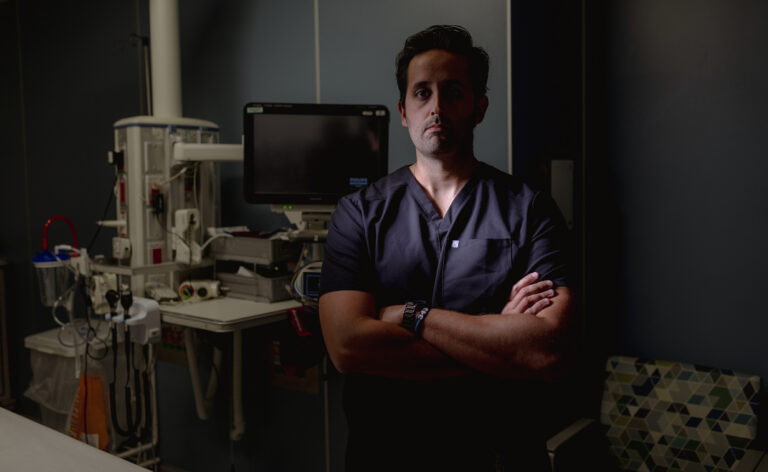
Emergency medicine physician Nicholas Cozzi, MD, won’t say “the q-word” as he walks through an empty section of Rush University Medical Center’s emergency department. The ER this morning is what nobody on staff likes to say, for fear of jinxing themselves: quiet.
But not for long. Cozzi mentally prepares for the surge that will start around 11 a.m. and last 18 hours. Four physicians will manage 65 patient rooms, while another 30 to 60 patients fill the waiting area. Some who make it out of the waiting area but remain without a dedicated room will sit in chairs lining the hallway. They’ll grab at Cozzi as he walks past, asking for help.
“People talk about how the system is breaking, but it’s not,” Cozzi says. “It’s broken. And in the emergency department, we’re seeing the collapse of the system all around us.”
Cozzi isn’t talking about Rush specifically. Emergency departments across Chicago and the country are overwhelmed. They’re crowded with patients who have put off care due to a swell of overlapping issues: lack of insurance, lack of a primary care provider, and fears around immigration enforcement. They put off medical attention until manageable issues become catastrophic. In two studies from 2022, Yale researchers detail widespread emergency department crowding nationwide that jeopardizes patient safety.
Emergency medicine physicians — who have among the highest burnout rates of any specialty, according to the American Medical Association — are caught between helping patients and navigating an overburdened healthcare system.
“The emergency department is an incredibly stressful environment. Part of that is intrinsic,” says Stefanie Simmons, MD, an emergency medicine physician and chief medical officer of the health worker advocacy nonprofit Dr. Lorna Breen Foundation. “But you’re also bearing the brunt of all of the failures of the healthcare system — the failures of access, treatment, follow-up. You’re doing your best to try to keep a boat afloat with chewing gum and sealing wax.”
Justin Fiala, MD, a pulmonary, sleep, and critical care physician in Chicago, says, “So many of us feel very deeply about doing no harm, but the system at every turn seems to want to do harm.”
Especially since the pandemic, Shikha Jain, MD, oncologist at UI Health, says physicians’ moral distress has been increasing. “They know what patients need, and they can’t provide it because of insurance issues, staffing limitations, financial barriers, and the rise of misinformation.”
As the challenges mount, physicians are left wondering if — and how — to access mental health support.
Violating values
Cozzi heads into work each day in black scrubs and work shoes, feeling like he’s going into battle. “I’m not battling patients but a system that rewards the wrong things. We are trying to take care of as many patients with continued reduction in resources and reimbursement,” he says.
From physicians to environmental services employees, healthcare workers have been coping with private-equity takeovers, hospital closures, administrative burdens, insurance denials, workplace violence, and more.
Jain says dealing with insurance companies is the biggest challenge. “I’m a triple-board certified hematologist/ oncologist who has spent several decades becoming a doctor and then practicing in my field,” she says. “So to have an insurance company tell me that I don’t know what I’m prescribing or that this patient should not be getting a certain medication is incredibly frustrating. It’s really demoralizing, a waste of time, and it’s frustrating because it hurts our patients.”
Insurance companies aren’t sitting across from a patient denying treatment. “They don’t have to have those hard conversations. We do,” Jain says.
Add to that, the corporatization of healthcare — driven by mergers and private equity buyouts — has made physicians’ workloads unmanageable. The Private Equity Stakeholder Project tracks private-equity-owned hospitals nationwide. As of September 2026, private equity firms owned 561 hospitals, about 10% of U.S. hospitals.
Because the funding structure is private, these hospitals lack transparency and oversight. Yet, research shows that common private equity approaches — including staffing cuts and price increases — lead to declining satisfaction among patients and providers, according to the Journal of the American Medical Association.
“At some point, healthcare went from patients first to profit first, and it went to a revenue-generating endeavor as opposed to a people’s health endeavor,” Jain says.

That shift began in the 1980s, when regulatory changes to U.S. financial and labor markets enabled private equity firms to flourish. By the early 2000s, firms had set their sights on healthcare and began acquiring hospitals, nursing homes, medical clinics, and more. Deals within the healthcare sector alone surpassed $100 billion in 2018, and firms have invested $1 trillion in the past decade, leading to a 25-fold increase in private-equity hospital ownership since the early 2000s.
“Most executives have come to see themselves as responsible not to physicians or to patients but rather to shareholders, who have one goal: maximizing profit,” writes Wendy Dean, MD, in her 2023 book If I Betray These Words. Dean describes physicians fleeing the grip of corporatized healthcare and looking for jobs “where they could practice medicine as they had been trained to do, not as corporate growth plans told them they must.”
Many physicians now describe moral injury — a term clinicians first used to describe Vietnam War veterans’ trauma and distress from working within a system at odds with their morals — as central to their experience. That feeling coincides with burnout. Burnout symptoms can show up after extended periods of high stress and include emotional exhaustion, overwhelm, and lack of empathy.
“To have an insurance company tell me that I don’t know what I’m prescribing or that this patient should not be getting a certain medication is incredibly frustrating. It’s really demoralizing, and it’s a waste of time.”
Studies show a correlation between burnout and lower quality of care and productivity. When burnout goes unaddressed, many physicians consider leaving the field, putting a healthcare system already facing shortages at greater risk. In 2025, 35% of physicians surveyed said they had considered leaving medical practice since the start of the year.
Some also consider ending their lives. More than 300 physicians die by suicide every year, and they’re at increased risk compared to the general population, according to recent research. In a 2025 study in the Journal of Psychiatric Research, 14% of healthcare workers reported suicidal thoughts, 6% reported planning, and 3.5% reported attempting suicide in the past year.
“Burnout rates shot up to 63% during the pandemic,” says Willie Underwood III, MD, president of the American Medical Association. “Fortunately, it’s down to 42%, but that’s too much.”
Many feel they don’t have the option of seeking mental health care. In fact, when physicians seek licensure, the application asks about felony convictions in the same space as it asks about mental health diagnoses, contributing to stigma and fear, Simmons says.
The stigma around seeking help
Emergency medicine physician Mila Felder, MD, spent her career at Advocate Christ Medical Center in Oak Lawn. She has worked to change language around physician mental health in Illinois and most recently served as vice president of well-being at Advocate, in addition to her clinical work in the ER.
Her interest in physician well-being stemmed from training residents. “There was a lack of awareness of mental health needs. Medical education and clinical practice inspired ‘healthcare heroes’ to just overcome and keep moving or appear weak or unfit,” she says.
The licensure and credentialing applications physicians fill out reinforce those ideas, Felder says, as does institutional and national culture.

So Felder got to work at each level. She started in 2020 by creating a peer- support program at Advocate Christ.
The group continues to meet virtually every week to learn about the complexities of stress and and to support each other, discuss challenging topics, and practice mindfulness.
“[The pandemic] was such a prime time for bringing mental health into the conversation because for the first time, there was a little bit more acceptance of ‘This is just me being human,’” Felder says.
The program at Advocate has grown to more than 7,000 participants nationally and is now part of onboarding at the system’s 69 hospitals and hundreds of ambulatory locations.
Troubling questions
After launching the peer-support program, Felder focused on national policy and partnered with the Dr. Lorna Breen Foundation. Breen’s family began the organization in 2020, after her death by suicide during the pandemic.
Breen, an emergency medicine physician in New York City when the pandemic started, spent long shifts at a Manhattan hospital treating hundreds of patients with Covid-19. She and her colleagues did their best with insufficient supplies, oxygen, beds, and support. Breen herself contracted the virus.
“Lorna faced deep exhaustion during the pandemic but feared that seeking mental health care would cost her the career she loved,” says a statement on the Foundation’s website.
Physician licensing boards have historically asked applicants about past mental health care, and hospitals have included similar questions in credentialing applications.
This section of questions exists to assess the physician’s moral fitness. “They include questions like: Have you been convicted of a felony? Are you a pedophile? And then have you ever been diagnosed or treated with a mental health condition?” Simmons says. “These moral fitness questions were someone’s best guess at how to keep the public safe, but we now know they do harm.”
Decades of healthcare workers have said the questions don’t actually help them stay healthy, and therefore don’t help keep the public safe.
Fiala sees the questions as penalizing. “It creates a culture of hush-hush when it’s an incredibly hard job, especially when things don’t go well,” he says. “It’s hard to know who you can reach out to because there is always this fear of professional retribution.”
Cozzi adds, “We’re flawed, imperfect people trained to care for others.”
Other physicians agree. In a health worker mental health survey from Chicago Health, one physician responded anonymously: “I lied on them all. We need to work. We all have burnout and PTSD.”
The Dr. Lorna Breen Foundation, along with the American Medical Association, state medical boards, and individual clinicians such as Felder, are advocating for a single licensing and credentialing question that doesn’t call out mental health specifically: Are you currently impaired in your duties for any reason?
“That could be physical health, mental health, age, any reason,” Simmons says. “And then if the answer is yes, the organization, because of the Americans with Disabilities Act, is beholden to ask what accommodations the person might need to be able to do their work.”
As of May 2026, 74 healthcare licensing boards, including the medical boards in 44 states, had changed their licensure questions, benefiting about 2.8 million licensed healthcare workers.

AMA President Underwood imagines the challenges outside of work that may lead a doctor to need mental health support: divorce, the death of a family member, “all kinds of things — there’s life!” Underwood says. “Doctors experience life like everyone else, and then to say, ‘If I seek help, with credentialing every two years, this is going to come up, and they’re going to wonder whether or not I should be able to practice medicine,’ — that should never happen. That should never be a part of the thought process.”
Since the Dr. Lorna Breen Foundation began recognizing organizations as Wellbeing First Champions for removing those questions, 1,427 hospitals, freestandingERs, and surgery centers, as well as nearly2,000 urgent care centers and independent primary care clinics, have verified that their credentialing applications don’t include them.
The designation is a selling point, Simmons says, “especially for residents and early-career folks who are more likely to have sought mental health care or to have a mental health diagnosis than any other generation, because they’re appropriately taking care of themselves.”
Felder and Simmons anticipate that the Illinois Department of Public Health (IDPH) will announce a change to hospitals’ credentialing questions this fall. The state is one of four that mandates very specific credentialing language. When she realized that, Felder, in her role at Advocate, brought key people together.
She formed the Chicagoland Chief Wellness Officer Forum with wellness officers from Northwestern, Rush, UChicago Medicine, and Endeavor. Chief wellness officer positions are relatively new in healthcare and have become more common in hospitals over the past decade. Felder enlisted Advocate’s government affairs team to draft a letter, which Chicago-area leaders signed and sent to IDPH.
Even after a state or licensing board makes a change, work remains to broadcast it. “If clinicians don’t know that these changes are happening, when it’s time for them to decide whether to seek care or not, their behavior is not going to change,” Simmons says.
Felder encourages organizational leaders to be vulnerable and speak out. “Bring in chief medical officers to understand, to then socialize, to then be comfortable speaking about their mental health, exposure, and challenges so that people within their organizations feel both empowered and supported to access the resources,” Felder says.
She mentions a physician who came to her, admitting to a suicide attempt the day before. The physician didn’t feel comfortable talking to anyone else. “So we talked through it,” she says. “And [they] got plugged into confidential, specialized resources. [They’re] very successful practicing at this point.”
Mental health care access obstacles
Physicians and experts say that mental health care access remains a challenge for physicians beyond perceived stigma. One of the biggest issues is scheduling.
“If you have a full clinic, inpatient responsibilities, overnight call, and hours of documentation waiting for you, when are you supposed to attend a therapy appointment?” Jain says.
Among physicians with moderate to severe depression, 70% report having major concerns around getting a mental health appointment that fits their nontraditional, long work hours.
“Therapy runs on a 9-to-5, Monday-to-Friday world. We don’t,” Cozzi says. “Our ‘free’ hours might be 7 a.m. on a Tuesday after a night shift, or a random Wednesday afternoon that becomes a Thursday afternoon next week.”
And there’s what Cozzi calls a quieter issue. Some physicians avoid using their hospital’s employee assistance program or health insurance for mental health care because they don’t trust that the record won’t impact their credentialing or licensing. “It’s coverage that exists on paper but that some physicians are too afraid to actually use,” Cozzi says.
More than 60% of physicians reported that their health insurance only covers mental health clinicians within their health system, and that privacy concerns make them less inclined to seek care.
Jain says physicians may worry about who could find out and fuel “perceptions about their ability to fulfill their duties as a physician. Those fears can discourage people from seeking help, even when they don’t reflect what an employer or licensing board actually requires.”
“You’re bearing the brunt of all of the failures of the healthcare system — the failures of access, of treatment, of follow-up. You’re doing your best to try to keep a boat afloat with chewing gum and sealing wax.”
For many physicians, pursuing mental health care boils down to finding an appointment that can fit a complex schedule, with a trusted clinician, without the experience touching their record.
“Health systems need to make seeking care practical: protected time, reliable coverage, affordable treatment, and clear confidentiality protections,” Jain says. “‘Please get help’ has to come with ‘We will make it possible for you to get help, and we won’t punish you for getting the help you need.’”
Looking for a better system
A physician who responded to Chicago Health’s survey on healthcare worker mental health wrote: “I burnt out and stopped caring. It just destroys your humanity to know that no matter how much you do, if it isn’t in the interest of monetary benefit, you’ll be disposable.”
The feeling isn’t foreign to Jain. “I love taking care of patients and being with patients,” she says. After a pause, she adds, “I think about leaving medicine on a weekly basis.”
Yet, her actions show the exact opposite. She turned that conviction into action by founding Women in Medicine, the nonprofit she started in 2019 to bring female physicians and other women in medicine together to learn from each other and share solutions to drive systemic change.
The organization focuses on opportunities for administrators and physicians to work together. “We’re working on creating these partnerships and collaborations so the right hand and the left hand know what each is doing, as opposed to decisions being made without understanding what’s happening to physicians and patients on the ground,” she says.
For Fiala, the solution is leaving — for now at least. This past spring, feeling increasingly beholden to metrics, he began looking for a new job.
He started looking throughout the state for a better work-life balance. When he didn’t find that, he contacted a recruiter to explore employment opportunities in other countries, eventually landing on New Zealand. Fiala thought back to the fear and overwhelm of the intensive care unit during the pandemic, and remembered the pang of jealousy he felt when he heard how New Zealand was taking the pandemic seriously.
“That said to me: That’s a place that values their people, and included in that is their healthcare professionals,” he says.
Fiala isn’t the only physician looking to leave. In a November 2025 report from Medscape, most expat physicians (70%) say they left to find better quality of life. Spain, Germany, and France rank highest among countries where expats practice, though Canada is also a draw. The Medical Council of Canada reported in July 2025 that the number of American doctors creating accounts to apply for jobs in Canada had increased more than 750% since the beginning of the year.
Fiala’s recruiter found a job that fit Fiala’s unique skill set: pulmonary and sleep medicine, with a focus on noninvasive ventilation. Before the interview, Fiala spoke with a future colleague who moved his family from Manhattan four years ago. The physician praised the work-life balance and how people treated each other with civility, night and day compared to the U.S., Fiala recalls him saying.
Cozzi says he noticed that drop in civility after the pandemic. “Covid more broadly in our culture broke something in us,” he says. “We’ve seen violence soar. We’ve had people killed in emergency departments across the country — doctors, nurses assaulted verbally and physically.”
Fiala was sold. As his December departure inches closer, he’s feeling most torn about the free sleep clinic he started on the city’s West Side five years ago. “That has been one of the most painful things to leave behind, because to me it feels almost like I’m abandoning a population in need when I know how bad the situation is,” he says.
Fiala has worked to improve the system, seeing hundreds of patients since the clinic started and offering sleep tests and CPAP machines so “people can actually get restful sleep, with ripple effects, such as decreased risk of car accidents due to sleepiness. That’s where my heart was with it this whole time,” he says.
Working in that space, though, showed him even more clearly how broken and unjust the system is, he says. “It’s one of the things that potentially contributed to me just needing a system that has universal healthcare, where people aren’t siloed outside of care.”
The clinic, CHI-PAP, operates out of the city’s largest volunteer-run clinic, CommunityHealth, located at Rockwell Street and Chicago Avenue. It will continue in Fiala’s absence.
“Starting that clinic was really healing in a lot of ways. It showed me certain ways in which people in society would reach out and want to help, to donate, so that was a tangible example of how people want to do good and help one another,” Fiala says.
At the same time, treating people who were denied care otherwise, or afraid to seek care once the immigration raids started, shook Fiala. “It made me feel like I didn’t recognize the country that I was living and working in,” he says. “It made me angry; it made me sad, and I think ultimately it made me think I’d be up for seeing what else is out there.”
Fiala doesn’t know how long he’ll stay in New Zealand, but he’s at least looking forward to getting a second summer this year.
From the Rush ER, Cozzi sighs. “The caregivers need to be healed because until we replenish our cup, we can’t provide care or healing for anyone else,” he says.
Cozzi seeks that healing in being present with his patients. He starts by introducing himself and acknowledging how long they’ve been waiting. I see you, he’s saying.
“And I say, ‘I can’t change the last 13 hours and 31 minutes, but if you give me a chance, maybe I can make the next 13 hours and 31 minutes better for you,’” he says.
He’s not trying to solve the healthcare crisis in these interactions, but to help somebody in need, to recognize their humanity.
“I hope that my colleagues and my generation can embrace more of that, because that’s the antidote for moral injury; that’s the antidote for burnout.
It’s feeling as though I can contribute,” Cozzi says. “That’s still within our power.”
Sometimes for him, that looks like getting a scared little boy a ball of Play-Doh before a CT scan. Other times, it’s an older couple who, after seven hours of tests, smile for the first time as they tell Cozzi their secret to a long marriage.
At the end of his shift, Cozzi will make the 45-minute drive home, sometimes in silence, other times listening to the Disney parade music he grew up with at the Magic Kingdom in the ’90s. The songs transport him to a time when everything felt possible, he says, before these heavier burdens were on his shoulders.
Chicago Health is part of the Mental Health Parity Collaborative, a group of newsrooms that are covering stories on mental health care access and inequities in the U.S. The partners on this project include The Carter Center and newsrooms in select states across the country.
Photo at top: Nicholas Cozzi, MD. Photo by Jim Vondruska
Originally published in the Fall 2026/Winter 2027 print issue.

An award-winning journalist, Katie has written for Chicago Health since 2016 and currently serves as Editor-in-Chief.